

Intentional dating means approaching every step of your romantic life with a clear sense of what you want and why. It helps single adults who are tired of wasted connections move faster toward relationships that actually fit. Start today with three actions: write down one core value your partner must share, add one honest sentence to your dating profile about what you're looking for, and ask one direct question on your next date ("What are you hoping to find right now?"). The rest of this guide gives you step-by-step templates, conversation scripts, a progress tracker, and research-backed tips to keep you moving forward.
- Clarify one value: Pick the single most important quality a partner must have. Write it down.
- Update your profile: Add one sentence that signals your purpose without sounding like a job posting.
- Ask the question: On your next date, ask what they're looking for. Their answer tells you everything.
Key Takeaways
Intentional dating works because it replaces ambiguity with clarity: you know what you want, you communicate it early, and you filter by values before chemistry.
| Point | Details |
|---|---|
| Define your non-negotiables | Keep the list to three or four values; longer lists become avoidance, not standards. |
| Communicate early | State your intentions in your profile and within the first few messages; ambiguity wastes time for both people. |
| Structure first dates | Use activity-based dates and ask two or three values-based questions within the first 60–90 minutes. |
| Track your progress | Review alignment score, conversation depth, and follow-up quality weekly to catch process problems early. |
| Veyadate for intentional daters | Veyadate's verified, activity-first platform helps you move from matched to meeting through real shared experiences. |
Table of Contents
- What does intentional dating actually mean?
- Why intentional dating helps: the real benefits
- How do you start intentional dating?
- How to use dating apps with purpose
- Common mistakes that undermine intentional dating
- How long does intentional dating take?
- Signs intentional dating is working
- Ready-to-use scripts and templates
- Research and expert insights that back this approach
- What actually changed when I started dating with intention
- Veyadate: built for people who want to meet, not just match
- Sources
What does intentional dating actually mean?
Cosmopolitan's therapist and dating-coach sources define intentional dating as approaching relationships with clarity about your personal values and goals, then making choices that align with those priorities. It is not a single relationship style. You can date intentionally while pursuing something casual, something committed, or something in between. The key is that you know what you want and you communicate it honestly.
Contrast that with how most people date. The default mode is chemistry-first: you swipe on attraction, chat until the conversation dies, meet for drinks, and see what happens. The primary filter is "do I feel something?" rather than "does this person share what matters most to me?" That's not wrong, but it produces a lot of mismatched connections and a lot of emotional fatigue.
Here's a quick side-by-side to help you self-check:
| Dimension | Passive dating | Intentional dating |
|---|---|---|
| Primary filter | Physical attraction or chemistry | Shared values and relationship goals |
| Communication style | Vague, "let's see where this goes" | Direct, early clarity about intentions |
| Pace | Momentum-driven | Deliberate, values-tested |
| Profile language | Generic ("love to laugh, travel") | Specific ("looking for something serious") |
| Decision point | Feelings in the moment | Alignment with stated priorities |
Consider the same person in two scenarios. In the first, they're open to something casual but want honesty and no games. They state that upfront, filter for people who agree, and enjoy a low-pressure connection that works for both. In the second, they want a long-term partner who shares their faith and wants children. They name those priorities early, ask about them on the first date, and don't invest months in someone who's on a different page. Both are intentional. Neither is rigid or joyless.
Why intentional dating helps: the real benefits
The most immediate payoff is less emotional exhaustion. When you filter by values before chemistry, you spend fewer evenings with people who were never going to work out. The Washington Post's wellness coverage frames intentional dating as a user strategy that directly lowers dissatisfaction with dating apps by encouraging mindful partner selection over sheer volume.

Clearer communication is the second big win. Ambiguity is the primary enemy of a good dating experience. When neither person says what they want, both people waste time reading signals and projecting hopes onto someone who may want something completely different. Honest, early communication is kinder than letting uncertainty linger for months.
Better matches and faster clarity on compatibility follow naturally. You're not waiting for a feeling to confirm what you should have asked about on date two. You already know the non-negotiables, so you recognize alignment when it shows up and misalignment before it costs you six months.
How do you start intentional dating?
Rachel Simeone's practitioner guide breaks the startup process into three practical phases: clarify, communicate, and meet. Here's how to work through each one.
Step 1: Clarify what you actually want
- Write down your top three relationship goals. Not "find love" — something specific: "a partner who wants to live in the same city long-term," "someone who shares my values around family," "a relationship where both people have independent lives."
- Identify three non-negotiable values. These are the qualities without which a relationship cannot work for you. Keep the list short. Long lists become checklists that filter out real people.
- Do an emotional readiness check. Ask yourself: Am I available to give attention to someone new? Am I still processing a past relationship? Honest answers here save you from starting the process before you're ready.
Think of it as choosing from a menu rather than grazing at a buffet. You're not sampling everything and hoping something satisfies you. You know what you came for.
Step 2: Communicate your intentions
State your intentions early, but not in a way that reads like a terms-and-conditions document. On a profile, one clear sentence is enough: "Looking for something serious with the right person" or "Open to something meaningful if the connection is real." In early messages, you don't need to lead with your five-year plan. A simple, warm signal works: "I'm at a point where I'm looking for something real. What about you?"
Simply Psychology's research confirms that early, honest communication about expectations increases the chance of compatible matches. The people who respond positively to your clarity are already more likely to be aligned with you.
Step 3: Structure your first date to test alignment
A 60–90 minute first date works best when it has a light structure. Skip the open-ended dinner where you talk about jobs and hometowns for two hours. Instead:
- Choose an activity that gives you something to do together (a walk, a market, a casual game). Activity-based dates reveal personality faster than a table across from each other.
- Ask two or three questions that matter: "What does a good week look like for you?" "What are you most excited about in your life right now?" "What does commitment mean to you?"
- Notice how they handle a small moment of friction or awkwardness. That tells you more than any answer.
Progress tracker (copy this weekly):
- Number of value-aligned matches this week: ___
- Dates that reached an intentional checkpoint (you asked at least one values-based question): ___
- Follow-up conversations that went deeper than small talk: ___
- Matches you declined because of clear misalignment: ___
Review these numbers every Sunday. If your aligned-match count is high but your follow-up rate is low, the problem is in your conversation approach. If your follow-up rate is high but you're not reaching checkpoints, you're avoiding the direct questions.
Pro Tip: Set a 10-minute weekly calendar block to update your tracker. Treating your dating life like a project you review — not just feel — is what separates intentional daters from everyone else.
How to use dating apps with purpose
Most app profiles are built to attract attention, not to filter for fit. A few targeted changes fix that.
Bio language that signals purpose without sounding stiff:
- "Here for something real, not just something easy."
- "Looking for a person, not a profile. Tell me what you're actually about."
- "Serious about finding the right connection. Casual about everything else."
Each of these communicates intention without reading like a relationship ultimatum. They invite the right people in and give the wrong ones a reason to scroll past.
- Photos: Lead with at least one activity photo that shows something you actually do. A photo of you hiking, cooking, at a concert, or playing a sport gives a match context before they message you. Context reduces the cold-start awkwardness of a blank opening message.
- Prompts: Use prompts to reveal priorities, not just personality. "The thing I'm most proud of" or "What I'm looking for" prompts do more filtering work than "My most controversial opinion."
- Filters: Use age, location, and relationship-goal filters seriously. Many apps let you filter by what someone is looking for. Use it. Swiping past that filter to "see what happens" undermines the whole approach.
- Opening messages: Skip "hey." Try: "Your photo at [place] caught my attention — what's the story there?" or "Your bio says [X] — I'm curious what that looks like day-to-day." These invite a real answer and signal that you read their profile.
Personality-first and activity-first app designs reduce cold-start fatigue significantly, especially for introverted daters who find blank-slate messaging draining. If you identify as an introvert, look for apps that offer community spaces, shared-interest groups, or activity-based prompts. They give you something to respond to rather than something to invent from nothing.
Pro Tip: Move from chat to a planned date within 5–7 messages. Longer chat threads feel safe but often replace the actual date rather than lead to one. Suggest a specific activity: "I've been wanting to try [place/activity] — want to make it a plan?"
Common mistakes that undermine intentional dating
The practice goes wrong in predictable ways. Here's what to watch for.
- Turning intention into a rigid checklist. A list of 15 non-negotiables is not intention. It's avoidance dressed up as standards. Counter-rule: keep your non-negotiables to three or four, and let curiosity handle the rest.
- Moving too fast emotionally. Intentional dating is not the same as fast dating. Clarity about goals doesn't mean you skip the getting-to-know-you phase. Counter-rule: pace your emotional investment to match what you actually know about the person, not what you hope is true.
- Misreading early signals as confirmation. Someone who texts back quickly and laughs at your jokes is interested. That's not the same as aligned. Counter-rule: test, don't assume. Ask the question directly instead of reading behavior as a proxy for compatibility.
- Interrogating instead of exploring. There's a difference between "What are you looking for?" asked with genuine curiosity and the same question fired off like a job interview. Counter-rule: ask curiosity questions, not interrogation questions. "What does a relationship look like for you at its best?" lands very differently than "Are you looking for something serious?"
- Using intention as a shield. If you find yourself filtering out every potential match before a first date, or ending things the moment something feels uncertain, your intentional practice may have become avoidant. Real intention includes tolerating some ambiguity while you gather real information.
Check yourself: if you haven't been on a date in two months because no one meets your criteria, the criteria are the problem, not the people.
How long does intentional dating take?
There's no universal timeline, and anyone who gives you one is selling something. What practitioners generally observe is that intentional daters reach clarity on compatibility faster than passive daters, because they're asking the right questions earlier. That doesn't mean they get to commitment faster. It means they waste less time on connections that were never going to work.
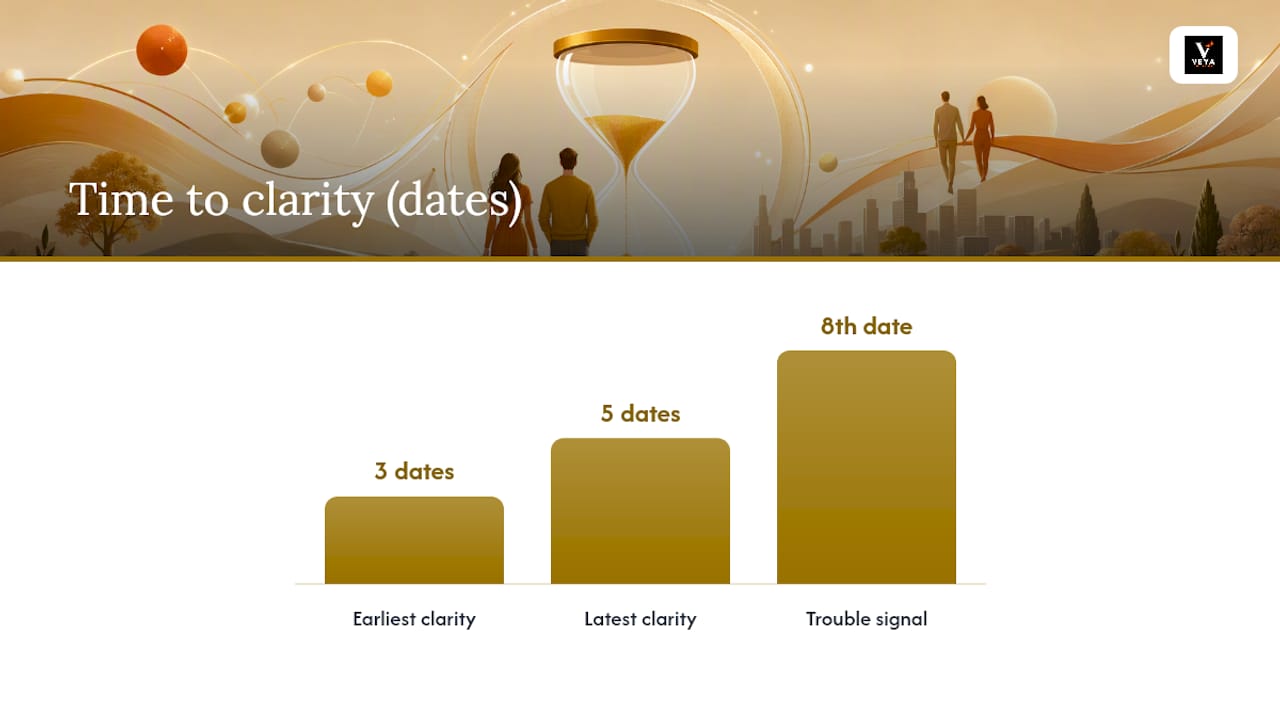
A rough pattern: most intentional daters know within three to five dates whether a connection has real potential. That's not a rule. It's a signal to pay attention to. If you're on date eight and still can't answer "do our values align?", something in your process is off, probably the questions you're asking or the answers you're accepting.
Progress looks like:
- Alignment score: After each date, rate (1–5) how aligned you felt on the things that matter most to you. Track it over time.
- Conversation depth: Did you learn something real about this person's values, not just their job and travel history?
- Follow-up quality: Is the conversation between dates getting more specific and personal, or staying at the surface?
Age, life stage, and availability all affect pace. Someone dating with two kids and a demanding job will move differently than someone with a wide-open schedule. Adjust your expectations to your actual life, not an idealized version of it. The Knot's guidance on intentional dating frames this as "purposeful patience" — moving deliberately without rushing commitment.
Signs intentional dating is working
You'll know the approach is working when you stop dreading dates and start looking forward to them as genuine information-gathering. More specifically:
- Your matches are talking about the future in concrete terms that match yours.
- Priorities are aligning on things that actually matter: how you handle conflict, what you want your daily life to look like, what commitment means to each of you.
- There's consistent reciprocity. They're investing at roughly the same pace you are.
- You've seen how they handle a small disagreement or disappointment, and you liked what you saw.
When those signals are present across multiple interactions, it's time to raise the exclusivity conversation. Keep it simple: "I've really enjoyed getting to know you, and I'd like to stop seeing other people. How do you feel about that?" That's it. No speech, no ultimatum. Just a clear, calm question.
If the answer is misalignment, handle it with the same directness. "I think we're looking for different things, and I'd rather be honest about that than keep going." Then use the experience as data: what did you learn about your own process? What question would have surfaced this earlier?
Ready-to-use scripts and templates
Three message scripts
Initial message (intention-signaling): "I noticed [specific detail from their profile]. I'm at a point where I'm looking for something real and I liked that your profile felt honest. What are you hoping to find?"
Date confirmation: "Looking forward to [activity] on [day]. I'll meet you at [place] at [time]. Anything you want to do or talk about while we're there?"
Exclusivity conversation opener: "I've really enjoyed spending time with you. I'd like to be with just you and stop seeing other people. Is that something you'd want too?"
Three example bios
Committed and clear: "Looking for a real relationship with someone who knows what they want. I value honesty, shared adventures, and a partner who's as interested in building something as I am."
Exploratory with clarity: "Not in a rush, but not here to waste anyone's time either. I'm looking for a genuine connection and open to seeing where it goes if the values are right."
Companionship-focused: "At a stage in life where I want a real partner, not just someone to fill the calendar. If you're looking for depth over novelty, let's talk."
Weekly intention-setting template
Fill this out every Sunday:
- My top relationship goal this week: ___
- One value I want to stay aligned with: ___
- One question I will ask on my next date: ___
- What I learned from last week's interactions: ___
- One thing I will do differently: ___
Pro Tip: Keep this template in your notes app. Reviewing it before a date takes two minutes and keeps you from defaulting to autopilot small talk.
Research and expert insights that back this approach
Simply Psychology's analysis of intentional dating is direct: ambiguity is the primary enemy. When you leave your intentions unstated, you're not being easygoing. You're creating a vacuum that both people fill with assumptions, and those assumptions almost never match. Early, honest communication is not pressure. It's respect.
For introverted daters, the app design matters as much as the approach. Analysis of personality-first dating apps shows that features like personality matching, communication-preference settings, and community spaces reduce the cold-start pressure that makes blank-slate messaging so draining for reflective people. If you find yourself avoiding the first message, the problem may be the app format, not your confidence. Look for platforms that give you context before you have to say anything.
The Washington Post's coverage positions intentional dating as an evidence-informed response to app fatigue. The problem with high-volume swiping isn't the apps themselves. It's the absence of a filter that matters. Mindful selection, not more matches, is what reduces dissatisfaction.
What actually changed when I started dating with intention
Before I understood what intentional dating meant in practice, I treated every date like an audition where I was both the performer and the judge. I was trying to be likable while simultaneously deciding if I liked them, and I never asked the questions that actually mattered. I'd leave dates thinking "that was fine" and then spend two weeks texting someone I already knew wasn't right.
The shift was small but decisive: I started asking one direct question per date about what the other person actually wanted. Not their job, not their travel plans. What they wanted from a relationship. The answers were clarifying in a way that no amount of chemistry-reading had ever been. Some people appreciated the directness and matched it. Others got uncomfortable, which was also useful information.
What felt different emotionally was that I stopped leaving dates in a fog of "maybe." I had something concrete to think about. And practically, I stopped investing weeks in connections that a single honest conversation would have resolved in the first hour.
If you want to try this for seven days, go back to the How do you start intentional dating? and run the three-step process on your next interaction. One week of intentional behavior is enough to feel the difference.
Veyadate: built for people who want to meet, not just match
Most dating apps are optimized for engagement, not for the kind of connection this article is about. Veyadate is built differently. It's an activity-first platform where every profile is photo-verified and every user is confirmed 18+, which means you're starting from a foundation of real people with real intentions.
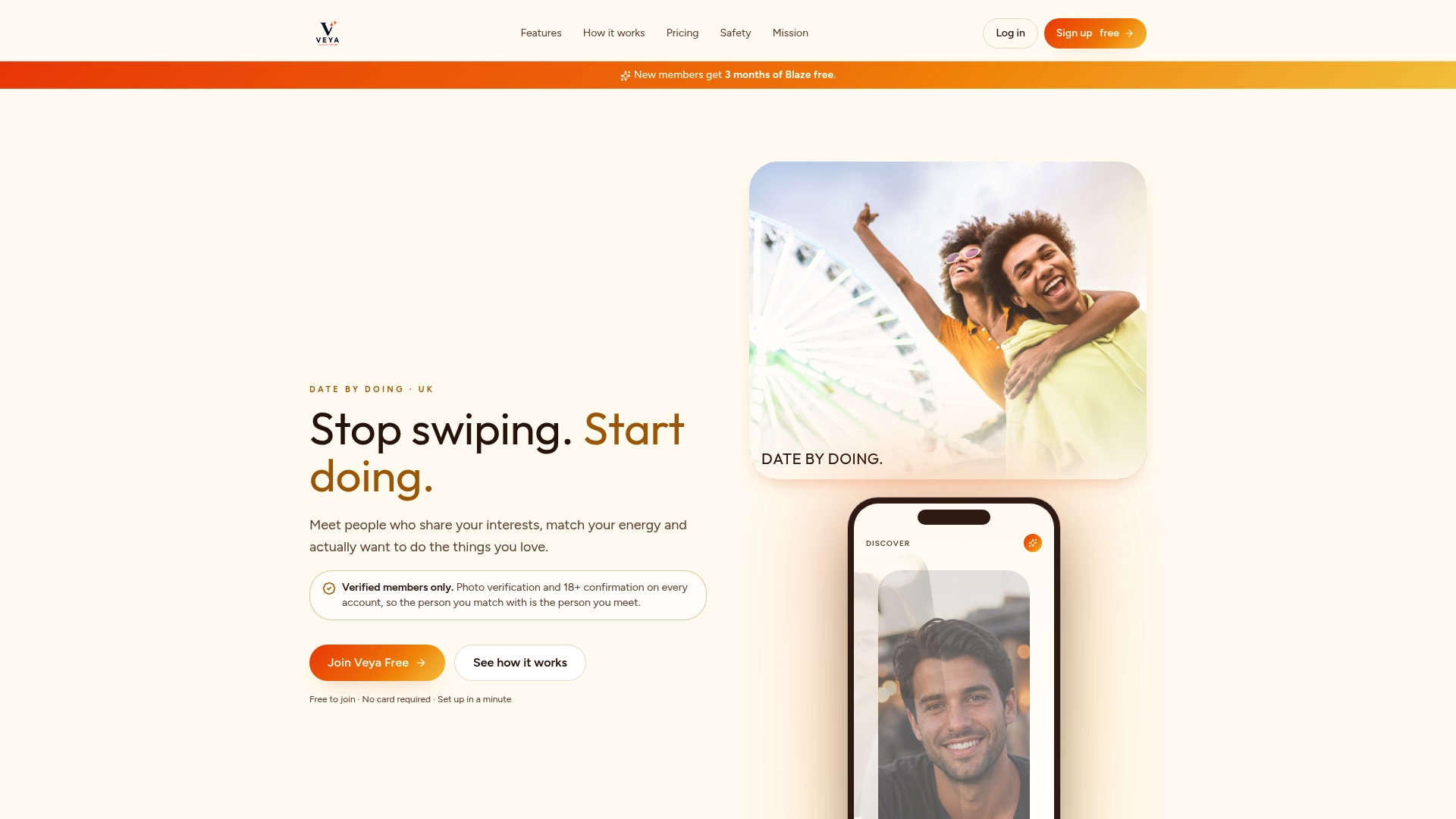
Where Veyadate stands apart for intentional daters: in-app chat games and icebreaker prompts give you something to respond to before the blank-message pressure kicks in, which is especially useful if you're a more reflective or introverted dater. City-specific date ideas built into the app mean you can move from match to a real, planned activity without the usual back-and-forth of "so what do you want to do?" The platform is designed to get you off the app and into an actual shared experience, which is exactly where intentional dating does its best work.
Join Veyadate and start meeting people through shared activities, not just shared screens.
Sources
- Dating with intention — Simply Psychology
- Disappointed by dating apps? This research-backed approach may help. — The Washington Post
- What Does “Intentional Dating” Really Mean? — Cosmopolitan
- Boo introvert dating app: Does personality matching work? — Ordinary Introvert